NumPy and Matplotlib for Physics problems

Pyhton 3
code
Jupyter Notebook
Numpy
Pandas
Matplotlib
Physics
Author

Dinda Gusti Ayu

Published

December 6, 2025

Basic NumPy and Graph Plotting with Matplotlib

This work aims to applying the concept of NumPy array and Matplotlib for solving physics problems by Python 3 and Jupyter Notebook. There are some solutions for tasks in this Python code.

Reference:

P5.1 - Correct Einstein’s mistakes

Special relativity is the area of physics deling with incredibly large velocities. In special relitivity, the momentum p of an object with velocity v(in m/s), and mass m (in kg) is given as.

\(p=m.v.\gamma, \gamma=\frac{1}{\sqrt{1-\frac{v^{2}}{c^{2}}}}\)

where c\(\approx\) 300.000.000 m/s is the speed of light. The program below attempts to calculate the momentum of an object with speed equal to 1/3 the speed of light, and mass m = 0.14 kg. The program has many errors, and doesn’t work. Copy and run the program. Correct the errors, and make it work like intended.

# Relativity Einstein
c = 3e8 # the speed of light in m/s
v = c / 3 # the velocity 1/3 the speed of light
m = 0.14 # mass in kg

# Calculate the relativity momentum
import numpy as np
gamma = 1 / (np.sqrt(1-(v/c)**2))
p_momentum = m * v * gamma

print(f'gamma = {gamma:.6f}')
print(f'p_momentum = {p_momentum:.6f}') # the momentum in kg m/s
gamma = 1.060660
p_momentum = 14849242.404917

P5.2 - Rydberg’s constant

Rydberg’s constant \(R_{\infty}\) for a heavy atom is used in physics to calculate the wavelength to spectral lines. The constant has been found to have the following value:

\(R_{\infty}=\frac{m_{e}e_{4}}{8\varepsilon_{0}{2}h^{3}c}\)

where, - \(m_{e}=9.109 x 10^{-31}\) m is the mass of an electron - \(e=1.602 x 10^{-19}\) C is the charge of a proton (also called the elementary charge) - \(\varepsilon_{0}=8.854 x 10^{-12}C V^{-1} m^{-1}\) is the electrical constant - h = 6.626 x \(10^{-34}\) J s is Planck’s constant - c = 3 x \(10^{8}\) m/s is the speed of light.

write the program which assigns the values of the physical constants to variables, and use the variables to calculate the value of Rydberg’s constant.

# Calculate Rydberg's constant
me = 9.109e-31 # mass of an electron
e = 1.602e-19 # the charge of a proton
varepsilon0 = 8.854e-12 # the electrical constant
h = 6.626e-34 # Planck's constant
c = 3e8 # speed of the light

R_infinity = (me * e**4)/(8 * varepsilon0**2 * h**3 * c)
print(f'R infinity = {R_infinity:.6e}') # the Rydberg's constant

P5.3 - Measure time

A ball is dropped straight down from a cliff with height \(\mathnormal{h}\). The position of the ball after a time \(\mathnormal{t}\) can be expressed as:

\(y(t)=v_{0}t - \frac{1}{2}at^{2} + h\)

where a is the acceleration (in \(m/s^{2})\) and \(v_{0}\) is the initial velocity of the ball (Measured in m/s). We wish to find for how long time \(t_{1}\) such that \(y(t_{1})=h_{1}\). The position of the ball is measured per \(\Delta{t}\) seconds.

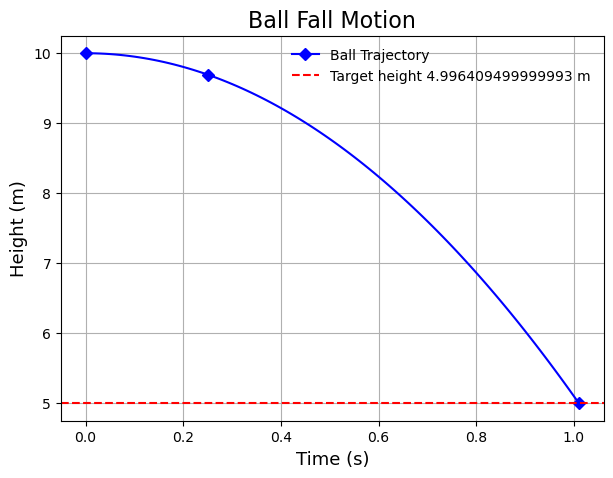
Write a program which finds out how long time \(t_{1}\) it takes before the ball reaches height \(h_{1}\) by using a while loop. \(h=10 m, y_{1}=5 m, \Delta{t}=0.01, v_{0}=0 m/s\) and \(a = 9.81 m/s^{s}\).

h = 10 # height in m
y1 = 5 # position of function of time t1 in m
v0 = 0 # velocity at t = 0 in m/s
a = 9.81 # acceleration due to gravity in m/s^2
dt = 0.01 # time step in s

# Calculate how long time t1, if y(t1) = h1.
y = h # initial positon
t = 0
t_values = [t]
y_values = [y]


# The position of the ball is measured per dt seconds
while y > y1:
    t = t + dt
    y = v0 * t - 0.5 * a * t**2 + h
    t_values.append(t)
    y_values.append(y)
    
# at this point, y <= y1
t1 = t
print(f'The ball reaches {y1} m after {t1:.2f} s.')

# The manual instruction
import numpy as np
ty1 = np.sqrt(2* (h - y1)/a)
print(f'The ball reaches {y1} after {ty1:.3f} s')

# Scatter plot with color map
import numpy as np
import matplotlib.pyplot as plt
from matplotlib.collections import LineCollection
t = np.linspace(0, 2, 200)
y = 10 -0.5 * 9.81 * t**2

# Create segments for line
points = np.array([t,y]).T.reshape(-1, 1, 2)
segments = np.concatenate([points[:-1], points[1:]], axis =1)

# colormap
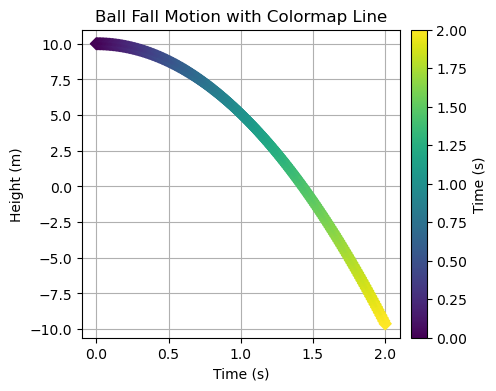
Lc=LineCollection(segments, cmap='viridis', linewidth=2, norm=plt.Normalize(t.min(), t.max()))
Lc.set_array(t) # color by time

fig, ax = plt.subplots(figsize=(5,4))
ax.scatter(t, y, c=t, cmap='viridis', marker='D')
ax.add_collection(Lc)
ax.autoscale()

# Adding colorbar
cbar = plt.colorbar(Lc, ax=ax, pad=0.03)
cbar.set_label('Time (s)')

ax.set_xlabel('Time (s)')
ax.set_ylabel('Height (m)')
ax.set_title('Ball Fall Motion with Colormap Line')
ax.grid(True)
ax.set_axisbelow(True)
plt.savefig('Ballmotion_colormap.svg', bbox_inches='tight')
plt.show('Ball Fall Motion')
The ball reaches 5 m after 1.01 s.
The ball reaches 5 after 1.010 s

h = 10 # height in m
y1 = 5 # position of function of time t1 in m
v0 = 0 # velocity at t = 0 in m/s
a = 9.81 # acceleration due to gravity in m/s^2
dt = 0.01 # time step in s

# Calculate how long time t1, if y(t1) = h1.
y = h # initial positon
t = 0
t_values = [t]
y_values = [y]


# The position of the ball is measured per dt seconds
while y > y1:
    t = t + dt
    y = v0 * t - 0.5 * a * t**2 + h
    t_values.append(t)
    y_values.append(y)
    
# at this point, y <= y1
t1 = t
print(f'The ball reaches {y1} m after {t1:.2f} s.')

# The manual instruction
import numpy as np
ty1 = np.sqrt(2* (h - y1)/a)
print(f'The ball reaches {y1} after {ty1:.3f} s')

import matplotlib.pyplot as plt

plt.figure(figsize=(7,5))
plt.plot(t_values, y_values, label= 'Ball Trajectory', marker='D', markevery=[0, 25, -1], color='b')
plt.axhline(y=y1, color='red', linestyle='--', label=f'Target height {y} m')
plt.xlabel('Time (s)',  fontsize=13, fontname='Sans serif')
plt.ylabel('Height (m)',  fontsize=13, fontname='Sans serif')
plt.title('Ball Fall Motion', fontsize=16, fontname='Sans serif')
plt.legend(framealpha=0)
plt.grid(True)
plt.show()
The ball reaches 5 m after 1.01 s.
The ball reaches 5 after 1.010 s

P5.4 - Free Fall Motion

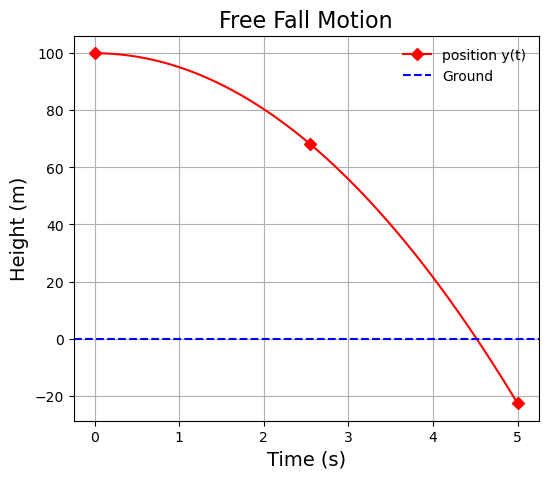
A ball is dropped from rest at a height of h = 100 m. The time intervals is 0.1 s up to 5 s. The constant gravitational acceleration g = 9.81 \(m/s^{2}\).(a) What time does the ball hit the ground, (b) what is the velocity of the ball and (c) plot the position of the ball vs time as it falls.

  • Free Fall Motion
    • Impact time (when y(t)=0)

      \(t_{ground}=\sqrt{\frac{2h_{0}}{g}}\)

    • Initial Velocity at the ground

      \(v_{ground}=gt_{ground}\)

    • Position

      \(y(t)=h_{0}-\frac{g}{t^{2}}\)

# (a) What time does the ball hits the ground with t_intervals = 0 - 5

# Basic numPy
import numpy as numpy

h0 = 100 # initial hight, in m
g = 9.81 #gravization in m/s^2


# Creating numpy arrays (np.linspace(start, stop, num) => the range built-in
t = np.linspace(0, 5, 50) # time interval 

# Position as a function of time
y = h0 - 0.5 * g * t**2

# time the ball hits the ground
t_ground = np.sqrt(2*h0/g)
print('(a) Ball hits the ground at t=',round(t_ground, 3), 's')

# Calculate the initial velocity of the ball 
v_ground = g * t_ground
print('(b) velocity at the ground =',round(v_ground, 3), 'm/s')

# Set plot the position of the ball vs time as it falls. 
import matplotlib.pyplot as plt
plt.figure(figsize=(6,5))
plt.plot(t, y, marker='D', markevery=[0, 25, -1], color='r', label='position y(t)')
plt.axhline(0, color='blue', linestyle='--', label='Ground')
plt.title('Free Fall Motion', fontsize=16, fontname='Sans serif')
plt.xlabel('Time (s)', fontsize=14, fontname='Sans serif')
plt.ylabel('Height (m)', fontsize=14, fontname='Sans serif')
plt.legend()
plt.legend(framealpha=0)
plt.grid(True)
plt.show()

# Scatter plot with color map
import numpy as np
import matplotlib.pyplot as plt
from matplotlib.collections import LineCollection
t = np.linspace(0, 5, 50)
y = h0 - 0.5 * g * t**2

# Create segments for line
points = np.array([t,y]).T.reshape(-1, 1, 2)
segments = np.concatenate([points[:-1], points[1:]], axis =1)

# colormap
Lc=LineCollection(segments, cmap='plasma', linewidth=3, norm=plt.Normalize(t.min(), t.max()))
Lc.set_array(t) # color by time

fig, ax = plt.subplots(figsize=(5,4))
ax.scatter(t, y, c=t, cmap='plasma', marker='D')
ax.add_collection(Lc)
ax.autoscale()


# Adding colorbar
cbar = plt.colorbar(Lc, ax=ax, pad =0.02)
cbar.set_label('Time (s)')

ax.set_xlabel('Time (s)')
ax.set_ylabel('Height (m)')
ax.set_title('Free Fall Motion')
plt.grid(True)
ax.set_axisbelow(True)
plt.savefig('Fallmotion_colormap.svg', bbox_inches='tight')
plt.show('Free Fall Motion')
(a) Ball hits the ground at t= 4.515 s
(b) velocity at the ground = 44.294 m/s

P5.6 -Relativistic Momentum

In classical physics, we define the momentum \(\mathnormal{p}\) of an object with mass \(\mathnormal{m}\) and velocity \(\mathnormal{v}\) as

                        $p=m x v$

A satellite with mass m = 1200 kg is trapped in the gravity of a black hole. It accelerates quickly from velocity \(v=0\) to \(v=0.9c\), where \(\mathnormal{c}\) is the speed of light, \(c\approx3x10^{8}\) m/s.

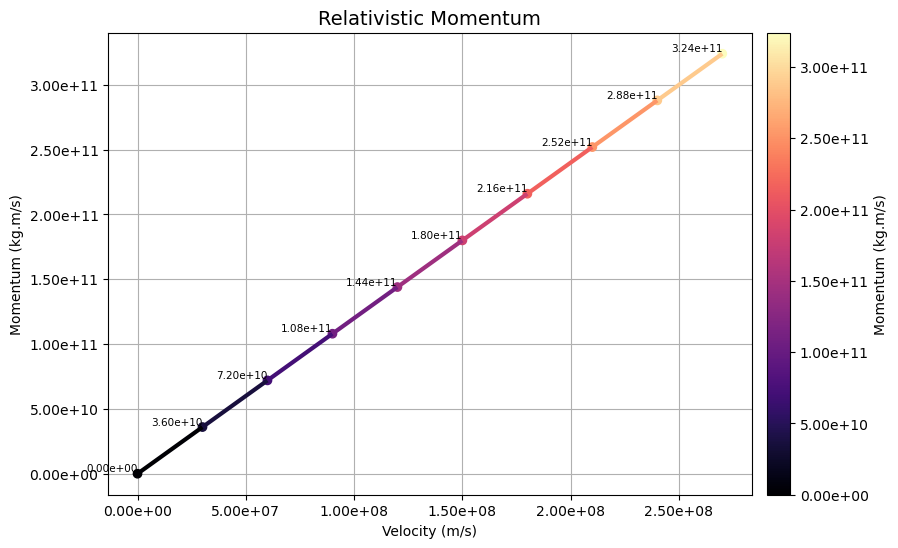
  1. write a program which prints a nicely formatted table to the terminal, containing the speed of the satellite in one column, and the momentum of the satellite in the other. Use time-intervals of \(0.1c\) between \(0c\) and \(0.9c\).

Hint: Use scientific notation ‘%e’ when printing the values, to avoid incredibly large floats. Alternatively, ‘%g’, which picks the best notation for you. Try to limit the number of decimals to a reasonable number.

# Parameters 
m = 1200 # mass of satellite in kg
c = 3e8 # the speed of light on m/s
 
print(f'{'Velocity (m/s)':>20} | {'Momentum (kg.m/s)':>25}')
print('-' * 45)

# Calculate momentum with the interval velocity 0 to 0.9c
# Use time-intervals 0f 0.1c between 0c and 0.9c
for i in range(10): # time interval from 0c to 0.9c
    v = i * 0.1 * c # velocity 0 - 0.9c, where c is the the speed of  light.
    p = m * v
    print('%20.3g | %25.3g' % (v, p)) # use scientific notation '%g' to limit the number of decimals
    

# Scatter plot with color map
import numpy as np
import matplotlib.pyplot as plt
from matplotlib.collections import LineCollection
v = np.linspace(0.0, 0.9, 10) * c
p = m * v #Classical Momentum

# Create segments for line
points = np.array([v,p]).T.reshape(-1, 1, 2)
segments = np.concatenate([points[:-1], points[1:]], axis =1)

# colormap
Lc=LineCollection(segments, cmap='magma', linewidth=3, norm=plt.Normalize(p.min(), p.max()))
Lc.set_array(p) # color by momentum

fig, ax = plt.subplots(figsize=(10,6))
ax.scatter(v,p, c=p, cmap='magma', marker='o')
ax.add_collection(Lc)
ax.autoscale()


# Adding colorbar
import matplotlib.ticker as ticker
from matplotlib.ticker import FormatStrFormatter
cbar = plt.colorbar(Lc, ax=ax, pad =0.02)
cbar.set_label('Momentum (kg.m/s)')
cbar.formatter = ticker.FormatStrFormatter('%.2e')
cbar.update_ticks()

# Axis labels and formatting
import matplotlib.ticker as ticker
from matplotlib.ticker import FormatStrFormatter
ax.set_xlabel('Velocity (m/s)')
ax.set_ylabel('Momentum (kg.m/s)')
ax.set_title('Relativistic Momentum', fontsize=14)
ax.xaxis.set_major_formatter(ticker.FormatStrFormatter('%.2e'))
ax.yaxis.set_major_formatter(ticker.FormatStrFormatter('%.2e'))
plt.grid(True)
ax.set_axisbelow(True)

# Add momentum values

for vx, px in zip(v, p):
    ax.text(vx, px, f'{px:.2e}', fontsize=7.5, ha='right', va='bottom')
plt.savefig('Relativistic_colormap.svg', bbox_inches='tight')
plt.show('Relativistic Momentum')
      Velocity (m/s) |         Momentum (kg.m/s)
---------------------------------------------
                   0 |                         0
               3e+07 |                   3.6e+10
               6e+07 |                   7.2e+10
               9e+07 |                  1.08e+11
             1.2e+08 |                  1.44e+11
             1.5e+08 |                   1.8e+11
             1.8e+08 |                  2.16e+11
             2.1e+08 |                  2.52e+11
             2.4e+08 |                  2.88e+11
             2.7e+08 |                  3.24e+11