Applying the concept of String, List and Loops, and Comparison and Flow Control for Chemistry exercises

Pyhton 3
code
Jupyter Notebook
Chemistry
Physics
Author

Dinda Gusti Ayu

Published

January 19, 2025

Strings, List and Loops, and Comparison and Flow Contol

This work aims to practice physics exercises using strings, list and loops, comparison dan flow control to solve the problem in Python. There are some solutions for tasks in this Python code.

Key Equation

  • Density Computations
    • \(\rho=\frac{m}{v}=\frac{nA}{V_{C}N_{A}}\)
  • Avogadro’s number
    • 6.022 x \(10^{23}\), 1 amu/atom (or molecule) = 1 g/mol

1. Strings

P3.1

Produce a nicely formatted list of the values of the physical constants, h, c, \(k_{B}\), R, and \(N_{A}\), to four significant figures, with their units.

h, h_units = 6.62607015e-34, 'J.s'
c, c_units = 299792458, 'm.s-1'
kB, kB_units = 1.380649e-23, 'J.K-1'
R, R_units = 8.314462618, 'J.K.mol-1'
N_A, N_A_units = 6.02214076e+23, 'mol-1'

s1 = (f'h = {h:9.3e} {h_units}\t'
     f'c = {c:9.3e} {c_units}\t' 
      f'kB = {kB:9.3e} {kB_units}\t'
       f'R = {R:9.3e} {R_units}\t'
        f'N_A = {N_A:9.3e} {N_A_units}\t')

s2 = (f'h   = {h:9.3e}{h_units}\n'
      f'c   = {c:9.3e}{c_units}\n' 
      f'kB  = {kB:9.3e}{kB_units}\n'
      f'R   = {R:9.3e}{R_units}\n'
      f'N_A = {N_A:9.3e}{N_A_units}\n')
print(s1)

print(s2)
h = 6.626e-34 J.s   c = 2.998e+08 m.s-1 kB = 1.381e-23 J.K-1    R = 8.314e+00 J.K.mol-1 N_A = 6.022e+23 mol-1   
h   = 6.626e-34J.s
c   = 2.998e+08m.s-1
kB  = 1.381e-23J.K-1
R   = 8.314e+00J.K.mol-1
N_A = 6.022e+23mol-1

P3.2

The following variables define some thermodynamic properties of \(CO_{2}\) and \(H_{2}O\).

# Triple point of CO2 (K, Pa)
T3_CO2, p3_CO2 = 216.58, 5.185e5
# Entalphy of fusion of CO2 (kJ.mol-1).
DfusH_CO2 = 9.019
# Entrophy of fusion os CO2 (J.K-1.mol-1).
DfusS_CO2 = 40
# Entalphy of vaporization of CO2 (kJ.mol-1).
DvapH_CO2 = 15.326
# Entrophy of vaporization of CO2 (J.K-1.mol-1).
DvapS_CO2 = 70.8

# Triple point of H2O (K, Pa)
T3_H2O, p3_H2O = 273.16, 611.73
# Entalphy of fusion of H2O (kJ.mol-1).
DfusH_H2O = 6.01
# Entrophy of fusion of H2O (J.K-1.mol-1).
DfusS_H2O = 22.0
# Entalphy of vaporization of H2O (kJ.mol-1).
DvapH_H2O = 40.68
# Entrophy of vaporization of H2O (J.K-1.mol-1).
DvapS_H2O = 118.89

print(' '*22 + 'CO2' + ' '*9 + 'H20')
print('_'*40)
print('p3     /pa         ', f'{p3_CO2:5.0f}      {p3_H2O:5.2f}')
print('T3     /K          ', f'{T3_CO2:5.2f}      {T3_H2O:5.2f}')
print('DfusH  /kJ.mol-1   ', f'{DfusH_CO2:5.3f}       {DfusH_H2O:5.3f}')
print('DfusS  /J.K-1.mol-1', f'{DfusS_CO2:4.1f}      {DfusS_H2O:6.1f}')
print('DvapH  /kJ.mol-1   ', f'{DvapH_CO2:5.3f}    {DvapH_H2O:8.3f}')
print('DvapS  /j.k-1.mol-1', f'{DvapS_CO2:5.1f}       {DvapS_H2O:5.1f}')
                      CO2         H20
________________________________________
p3     /pa          518500      611.73
T3     /K           216.58      273.16
DfusH  /kJ.mol-1    9.019       6.010
DfusS  /J.K-1.mol-1 40.0        22.0
DvapH  /kJ.mol-1    15.326      40.680
DvapS  /j.k-1.mol-1  70.8       118.9

P3.3

Nuclear binding energy and the mass defect. A neutron has a slightly larger mass than the proton. These are often given in terms of an atomic mass unit, where one atomic mass unit (u) is defined as 1/12th the mass of a carbon-12 atom.

# Mass Particle constant, in kg.
atomic_kg = 1.660540 * 10 ** -27
neutron_kg = 1.674929 * 10 ** -27
proton_kg = 1.672623 * 10 ** -27 
electron_kg = 9.109390 * 10 ** -31

# Mass particle, in u.
atomic_u = 1.000 
neutron_u = neutron_kg / atomic_kg 
proton_u = proton_kg / atomic_kg
electron_u = electron_kg / atomic_kg

# Mass particle, in MeV/c2
atomic_ev = 931.5
neutron_ev = neutron_u * atomic_ev
proton_ev = proton_u * atomic_ev
electron_ev = electron_u * atomic_ev


title = '|' + ' '*19 + '{:43}'.format('Binding Nuclear Energy') + '|'
line = '+' + '-'*16 + '+' + ('-'*14 + '+')*3
row = '|{:<15} |' + ' {:12} |'*3
header = '| {:^14} |'.format('Particle') + (' {:^12} |'*3). format('Mass (kg)', 'Mass (u)', 'Mass (Mev/c2)')

print('+' + '-'*(len(title)-2) + '+',
      title,
      line,
      header,
      line,
      row.format('atomic mass', atomic_kg, f'{atomic_u:8.3f}', f'{atomic_ev:6}'),
      row.format('neutron', neutron_kg, f'{neutron_u:8.7f}', f'{neutron_ev:8.2f}'),
      row.format('proton', proton_kg, f'{proton_u:8.7f}', f'{proton_ev:8.2f}'), 
      row.format('electron', electron_kg, f'{electron_u:8.7f}', f'{electron_ev:8.3f}'),
      line,
      sep='\n')
                                                                   
+--------------------------------------------------------------+
|                   Binding Nuclear Energy                     |
+----------------+--------------+--------------+--------------+
|    Particle    |  Mass (kg)   |   Mass (u)   | Mass (Mev/c2) |
+----------------+--------------+--------------+--------------+
|atomic mass     |  1.66054e-27 |    1.000     |  931.5       |
|neutron         | 1.674929e-27 | 1.0086653    |   939.57     |
|proton          | 1.672623e-27 | 1.0072765    |   938.28     |
|electron        |  9.10939e-31 | 0.0005486    |    0.511     |
+----------------+--------------+--------------+--------------+

2. List and Loops

P3.4

Straight-chain alkanes are hydrocarbons with the general stoichiometric formula \(C_{n}H_{2n+2}\), in which the carbon atoms form a simple shain: for example, butane, \(C_{4}H_{10}\) has the structural formula that may be depicted \(H_{3}CC_{2}CH_{2}CH_{3}\). Write a progra, to output the structural formula of such an alkane, given its stoichiometry (assume \(n\geq1\)).

# Assume n = 5
stoich = 'C5H12'
fragments = stoich.split('H')
nC = int(fragments[0][1:])
nH = int(fragments[1])
if nH != 2*nC + 2:
    print('{} is not alkane!'.format(atoich))
else:
    print('H\u2083C', end='')
    for i in range(nC-2):
        print('-CH\u2082', end='')
    print('-CH\u2083')
H₃C-CH₂-CH₂-CH₂-CH₃

P3.5

Produce a table if the FCC element symbols abd their corresponding atomic radius (nm) and atomic weight (g/mol).

symbols = ['Al', 'Cu', 'Au', 'Pb', 'Ni', 'Pt', 'Ag']
Atomic_radiuss = [0.1431, 0.1278, 0.1442, 0.1750, 0.1246, 0.1387, 0.1445]
Atomic_weigth = [26.981, 63.546, 196.966, 206.14, 58.693, 195.084, 107.868]
line = '-'*52
print(line)
print('Elements | Atomic Radii (nm) | Atomic weight (g/mol)')
print(line)
for i in range(len(symbols)):
    print(' '*2, symbols[i], ' '*5, Atomic_radiuss[i], ' '*13, Atomic_weigth[i])
    print(line)
----------------------------------------------------
Elements | Atomic Radii (nm) | Atomic weight (g/mol)
----------------------------------------------------
   Al       0.1431               26.981
----------------------------------------------------
   Cu       0.1278               63.546
----------------------------------------------------
   Au       0.1442               196.966
----------------------------------------------------
   Pb       0.175               206.14
----------------------------------------------------
   Ni       0.1246               58.693
----------------------------------------------------
   Pt       0.1387               195.084
----------------------------------------------------
   Ag       0.1445               107.868
----------------------------------------------------

P3.6

reference: - https://en.wikipedia.org/wiki/Atomic_radii_of_the_elements_(data_page)

Alumunium, copper and lead has an atomic radius of 121, 132, and 146 nm, respectively, an FCC crystal structure, and atomic weight of 26.98, 63.55, and 207.20 g/mol. Compute their theoritical density,and compare the answer with their measured density.

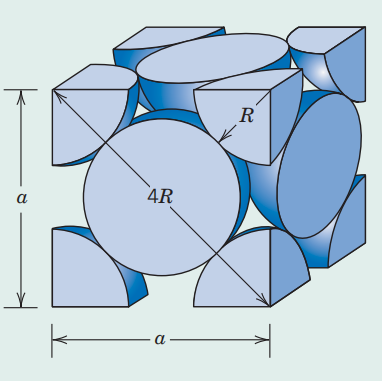
Face centered cubic (fcc) structure

image.png

Credit: Callister & Rethwisch

in the FCC unit cell illustrated, the atoms touch one another across a face-diagonal, the length of which is 4R. Because the unit cell is a cube, its volume is \(a^{3}\), where a is the cell edge length. From the right triangle on the face.

\(a^{2} + a^{2} = (4R)^{2}\)

Solving for a,

\(a=2R\sqrt{2}\)

The FCC unit cell volume \(V_{C}\) may be computed from

\(V_{C}=a^{3}=(2\sqrt{2})^{3}=16R^{3}\sqrt{2}\)

import numpy as np
# Avogadro's number , in atoms/mol.
NA = 6.022 * 10 **23

# The number of atoms per unit cell in FCC
n = 4

# The atomic weight, and Radii of atoms (use floats/ints instead of strings)
Atomics = ['Al', 'Cu', 'Pb'] # use string ' '
A_weight = [26.98, 63.55, 207.20] # atomic weights in g/mol use float
Radii = [143 * 10 **-10, 128 * 10 **-10, 180 * 10 **-10] # radii in cm (converted from pm) use float/integers

# Computational density
for atom, weight, radius in zip(Atomics, A_weight, Radii):
    V_cell = 16 * (radius**3) * np.sqrt(2)
    m_cell = 4 * weight
    rho = m_cell / (V_cell *NA)
    print(f" {atom}: V_cell={V_cell:.3e} cm^3, m_cell={m_cell:.3e} g, rho={rho:.3f} g/cm^3")
 Al: V_cell=6.617e-23 cm^3, m_cell=1.079e+02 g, rho=2.708 g/cm^3
 Cu: V_cell=4.745e-23 cm^3, m_cell=2.542e+02 g, rho=8.895 g/cm^3
 Pb: V_cell=1.320e-22 cm^3, m_cell=8.288e+02 g, rho=10.429 g/cm^3

3. Comparison and Flow Control

Table. Python comparison operators
Symbols meaning
== Equal to
!= Not equal to
> Greater than
< Less than
>= Greater than or equal to
<= Less than or equal to

P3.7

Determine whether each of the following electron configuration is an inert gas,a halogen, an alkali metal, an alkaline earth metal, or transition metal. Justify your choices.
(a) 1s2.2s2.2p6.3s2.3p5
(b) 1s2.2s2.2p6.3s2.3p6.3d7.4s2
(c) 1s2.2s2.2p6.3s2.3p6.3d7.4s2.4P6
(d) 1s2.2s2.2p6.3s2.3p6.4s1
(e) 1s2.2s2.2p6.3s2.3p6.3d7.4s2.4p6.4d10.5s2
(f) 1s2.2s2.2p6.3s2
# Electron configuration
configs = {
    '(a)': '1s2.2s2.2p6.3s2.3p5',
    '(b)': '1s2.2s2.2p6.3s2.3p6.3d7.4s2',
    '(c)': '1s2.2s2.2p6.3s2.3p6.3d10.4s2.4p6',
    '(d)': '1s2.2s2.2p6.3s2.3p6.4s1',
    '(e)': '1s2.2s2.2p6.3s2.3p6.3d7.4s2.4p6.4d5.5s2',
    '(f)': '1s2.2s2.2p6.3s2'}

def classify_configuration(cfg: str):
    subshells = cfg.split(".")
    parsed = []

    # Parse subshells into (n, orbital, electrons)
    for s in subshells:
        try:
            n = int(s[0])          # principal quantum number
            orbital = s[1]         # orbital type (s, p, d, f)
            electrons = int(s[2:]) # electron count
            parsed.append((n, orbital, electrons))
        except:
            continue

    if not parsed:
        return "Unknown"

    #Classify configuration electron by the last and the second-last subshells
    last_orbital, last_e = parsed[-1][1], parsed[-1][2]
    second_orbital, second_e = parsed[-2][1], parsed[-2][2] if len(parsed) >= 2 else (None, None)

    # Rules
    if last_orbital == "p" and last_e == 6:
        return "Inert gas (Noble gas)"
    elif last_orbital == "p" and last_e == 5:
        return "Halogen"
    elif last_orbital == "s" and last_e == 1:
        return "Alkali metal"
    elif last_orbital == "s" and last_e ==2:
        if second_orbital == "p" and second_e == 6:
            return "Akaline Earth metal"
        elif second_orbital =="d" and second_e <10:
            return "Transition metal"
 
# print results
for label, cfg in configs.items():
    print(f"{label} {cfg} => {classify_configuration(cfg)}")
(a) 1s2.2s2.2p6.3s2.3p5 => Halogen
(b) 1s2.2s2.2p6.3s2.3p6.3d7.4s2 => Transition metal
(c) 1s2.2s2.2p6.3s2.3p6.3d10.4s2.4p6 => Inert gas (Noble gas)
(d) 1s2.2s2.2p6.3s2.3p6.4s1 => Alkali metal
(e) 1s2.2s2.2p6.3s2.3p6.3d7.4s2.4p6.4d5.5s2 => Transition metal
(f) 1s2.2s2.2p6.3s2 => Akaline Earth metal